GOP looks to fight Dems, not negotiate with Obama
Published 11:37 am Monday, January 28, 2013
WASHINGTON (AP) — Is Washington’s backroom dealing dead?
House Speaker John Boehner says he no longer wants to negotiate deficit reduction with President Barack Obama. The president says he won’t negotiate raising the government’s borrowing authority. Rank and file lawmakers say they’re tired of being left out of the loop and insist on the regular legislative process.
If those are New Year’s resolutions, they can certainly be broken. But at the start of a second presidential term, cutting a secret, late night fiscal bargain with the White House on the phone and with a handshake suddenly seems so yesterday.
“No more brinkmanship,” Senate Republican leader Mitch McConnell declared. “No more last-minute deals.”
What’s in, for the moment at least, is a more deliberative legislative process. House Budget Committee Chairman Paul Ryan, last year’s Republican vice presidential nominee, says it’s all about “prudence.”
For the nation, that could mean less manufactured drama like the New Year’s deal that averted the once-dreaded “fiscal cliff.” For the stock market, it might mean less political volatility. And for the economy, it could provide a dash of needed stability.
The reasons for this turn are fundamentally political.
Republicans are less interested in battling a re-elected Obama, with his higher popularity ratings, than they are in confronting Senate Democrats. Last week’s tactical retreat by House Republicans from a clash over the nation’s borrowing authority is forcing the Senate’s Democratic majority to assemble a budget, making Democratic senators accountable for a series of specific policies and clarifying differences between the parties ahead of the 2014 midterm elections.
Unlike the emerging bipartisanship on an overhaul of immigration laws, conflicts over budgets and deficits frequently have been resolved in a crisis atmosphere. And while immigration changes have been pushed by a changing political landscape, issues of spending and taxing define the core of both parties.
Republicans and the White House have tried twice in two years to reach a “grand bargain” to reduce the long-term deficit only to settle for a smaller incremental deal. The process has tested the relationship between Obama and Boehner and created tensions for Boehner with his own Republican lawmakers. In the process, lawmakers had to vote urgently on deals many had barely seen.
“Cooling your heels for 72 hours or 48 hours while there’s some backroom deal going on that cannot be discussed is not exactly why people ran for the Senate,” said Sen. Bob Corker, R-Tenn., who had unveiled his own 10-year, $4.5 trillion solution for averting the end-of-year fiscal cliff.
What’s more, Republican officials have complained that Obama lectured congressional leaders during their meetings, trying to persuade rather than negotiate. White House officials, for their part, complain that Boehner was an uncertain negotiator, never able to guarantee that his party would stand by an agreement.
As Boehner himself confessed last week in a speech to the Republican Ripon Society: “The last two years have been pretty rough.” He said newer Republicans lawmakers have come to think of him as “some kind of a squish, ready to sell them out in a heartbeat.”
“It really has in fact caused somewhat of breach that I’ve been in the middle of trying to repair,” Boehner said.
While the fight over the government’s borrowing limit is now likely to be put off until May, Obama and the Congress still face two upcoming fiscal deadlines that could test this unwillingness for 11th-hour White House negotiations. Tough new spending cuts — about $85 billion from this year’s budget — are scheduled to kick in on March 1. On March 27, the government faces a potential shutdown if Congress doesn’t extend a temporary budget measure.
But at the White House and in Congress, both are seen as far less cataclysmic than failure to raise the nation’s debt ceiling. And Republican lawmakers who once shuddered at the idea of massive cuts, especially to defense programs, now see the automatic reductions on March 1 as the only recourse to reduce spending.
“It’s the bird in hand when it comes to cuts,” said Sen. John Cornyn, the second ranking Republican leader in the Senate.
More unclear is how Republicans intend to deal with the debt ceiling in May, when Congress again will have to act to raise it or extend it.
The White House is no more enthusiastic for last-minute deal making than Republicans are. Fiscal negotiations have been time consuming events that have left Obama with little time to pursue other aspects of his agenda.
If freed from such talks, he can now push his proposals for overhauling immigration laws and combating gun violence.
“Going regular order slows things down and takes the president out of a central role but it’s still an influential one if he wants it,” said Patrick Griffin, White House legislative director under President Bill Clinton. “The more it looks like he’s winning, the better the next battle goes for him.”
What’s more, White House officials say, Obama’s negotiating stance is now well known after he made a public offer to Boehner in December that Boehner turned down. That offer, White House officials say, still stands: Lower cost-of-living adjustments for Social Security recipients and other beneficiaries of government programs, $400 billion in reduced spending in Medicare and other health care programs over 10 years, and $600-$700 billion in tax revenue from closing loopholes and deductions by rewriting the tax code.
In a memorandum to her colleagues, the new Senate Budget Committee chair, Sen. Patty Murray, D-Wash., emphasized that “we could raise hundreds of billions of dollars by making sure the rich no longer benefit disproportionately from deductions and other tax preferences.” The letter did not specify an amount of revenue. Republicans say any new tax revenue is out of the question.
In 2014, there are 35 Senate seats up for election, 21 held by Democrats. Republicans see that as an opportunity to pick up some seats and they see a clash over taxes as a winning proposition, especially in states Obama lost.
Moreover, a Democratic budget will test whether Democrats will embrace the Medicare cuts and Social Security changes that Obama proposed privately in previous unsuccessful talks with Republicans.
“The president hasn’t offered any of those kinds of plans in public,” Ryan said Sunday on Meet the Press. “They try to do back room deals, but those always seem to fall apart. We want to have a debate in public so we can contrast these visions.”
Associated Press White House Correspondent Julie Pace contributed to this article.
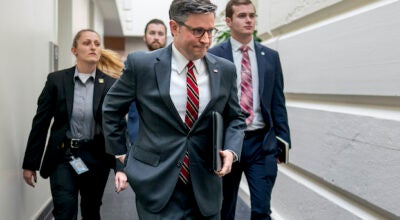
Speaker of the House John Boehner